One Name. Three Layers of the Internet
How a brand TLD became the identity layer for humans, brands, and AI agents
Author: Nic.Kred Research
What Is .Kred
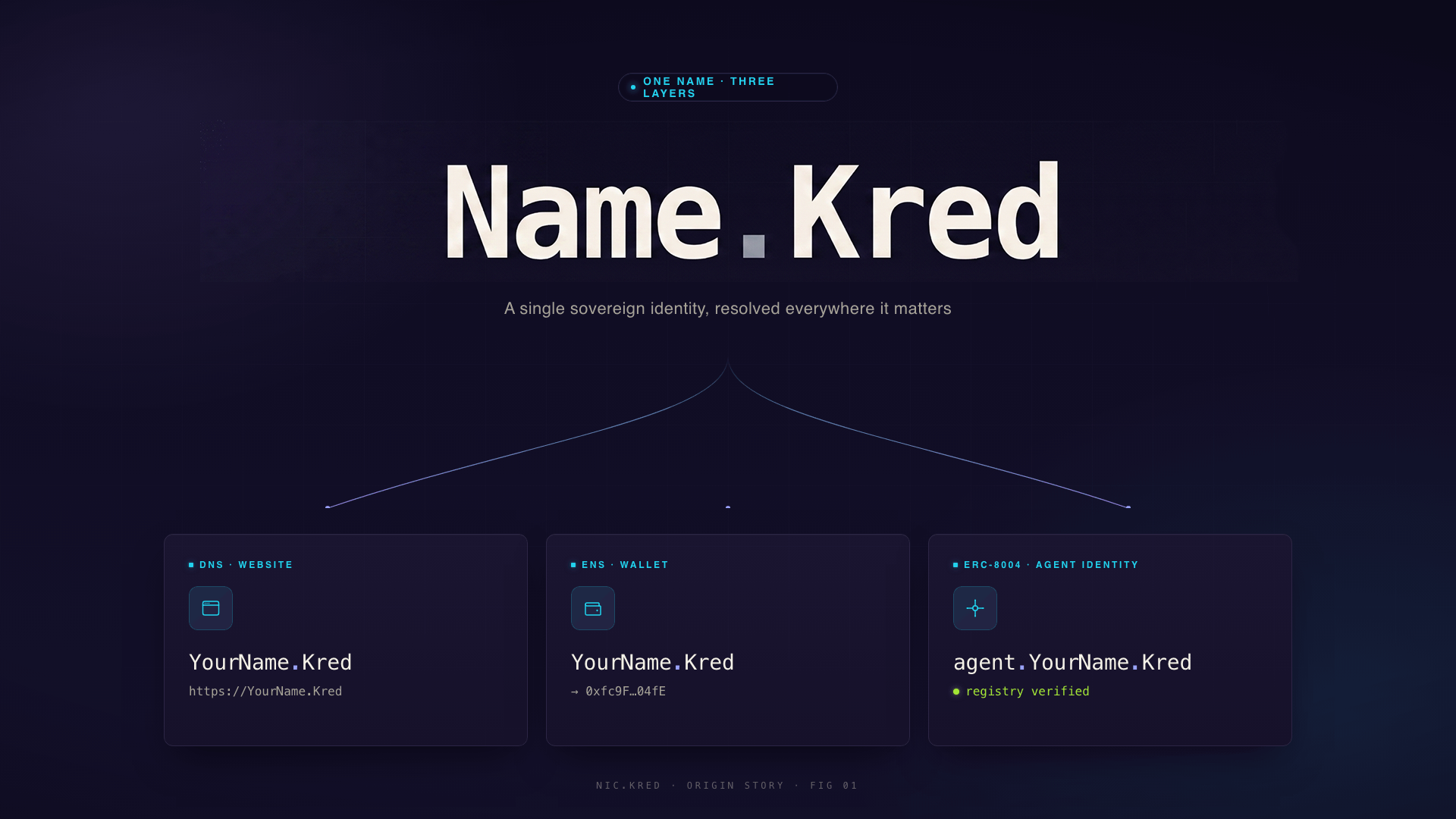
.Kred is an ICANN-approved top-level domain. Every name registered in the .Kred root resolves simultaneously as a website, as a wallet, and - through the agent-identity layer added in 2026 - as a verifiable AI agent. The domain is the brand. The brand is the identity.
The registry behind .Kred is KredTLD, a brand operated by PeopleBrowsr, the social identity, reputation, and tokenization company that has measured 400 million social profiles, indexed one trillion conversations, and built sovereign infrastructure across identity, reputation, and tokenization (over 130 million NFTs across more than 100 brands) for the better part of two decades. The full parent-company arc - DARPA, NFTs, NFT.NYC, and the agentic-web framework - lives in the PeopleBrowsr Manifesto. This article is the .Kred-shaped slice of that story.
Behind every .Kred name sits a Kred Domain Token - an ERC-721 record on Base that grants its holder sovereign control of the name across DNS and ENS in a single signature. The DNS servers act as a cache of the on-chain record. Updates written to Base propagate to the global DNS within approximately one minute, with no further input from the holder.
"Kred is doing really innovative work combining DNS and ENS. This is a great step toward our goal of leveraging the Ethereum blockchain to complement and expand the usefulness of DNS."
- Brantly Millegan, Director of Operations, Ethereum Name Service (ENS), March 2020
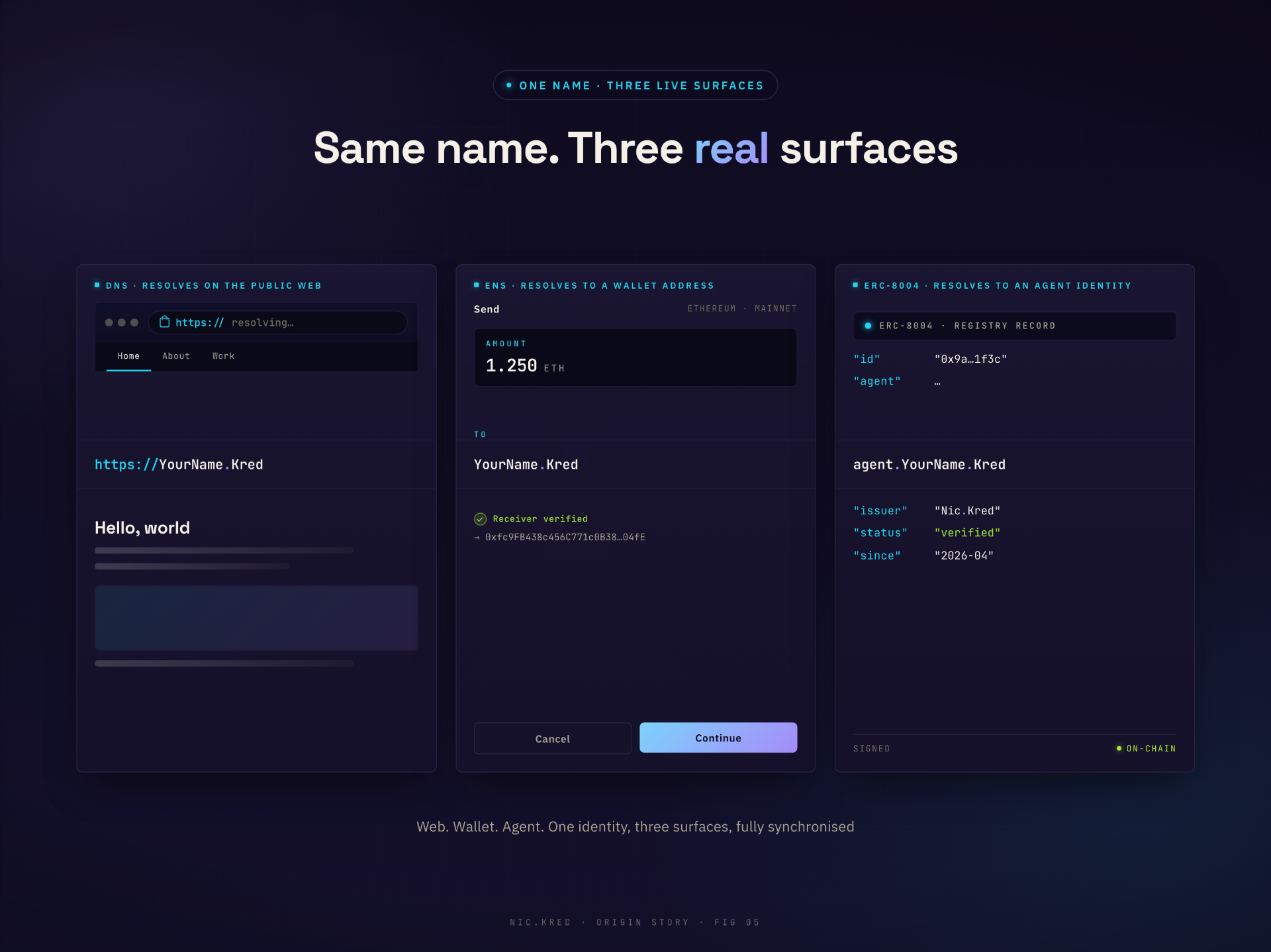
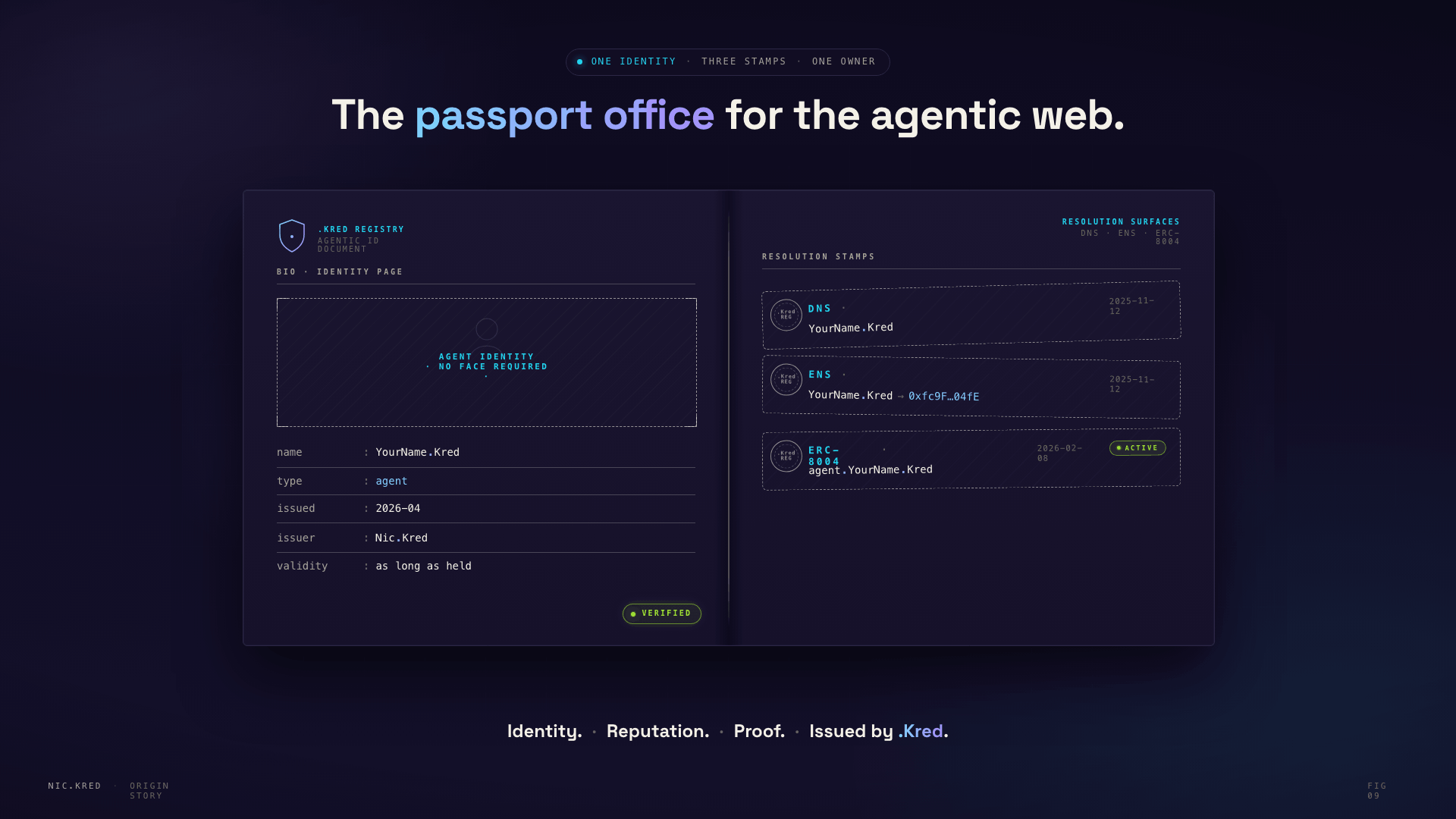
The combination is unique in the namespace. .eth resolves on Ethereum and not on DNS. .com resolves on DNS and not on Ethereum. .Kred resolves on both, and now on the ERC-8004 agent registry as a third layer. One name. Three layers of the internet. One owner.
Then - The Influence Score (2007 to 2017)
The Trillion Conversation Datamine
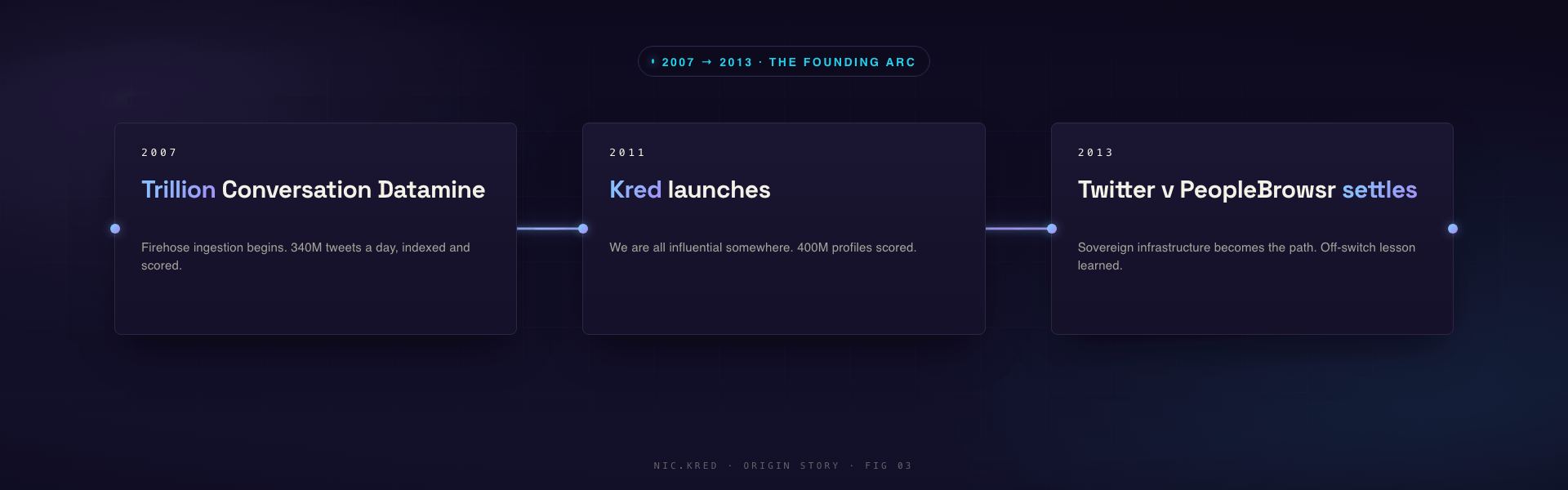
PeopleBrowsr launched in San Francisco in 2007 with a simple thesis: the most important data in the world was in what people were saying to each other, right now, out loud, on the internet. The team plugged directly into the Twitter firehose - every public tweet, 340 million tweets per day - and began indexing and scoring what it found. The resulting archive grew into the Trillion Conversation Datamine, one of the largest real-time records of human social behavior ever assembled.
ReSearch.ly launched on top of that archive as what the press called "Google for social media" - offering 1,000 days of searchable Twitter history when Twitter's own interface only showed the last few hours. The product trained the team on the discipline that would define everything afterwards: assemble the signal yourself, score it transparently, and let the user audit the math.
Kred - we are all influential somewhere
Kred launched in 2011 on a radical premise for its time: we are all influential somewhere. Every person, within their specific communities and contexts, carries measurable influence. Kred refused to rank everyone on a single global leaderboard. The system found the communities where you mattered, and scored you there.
The dual-score architecture was the innovation:
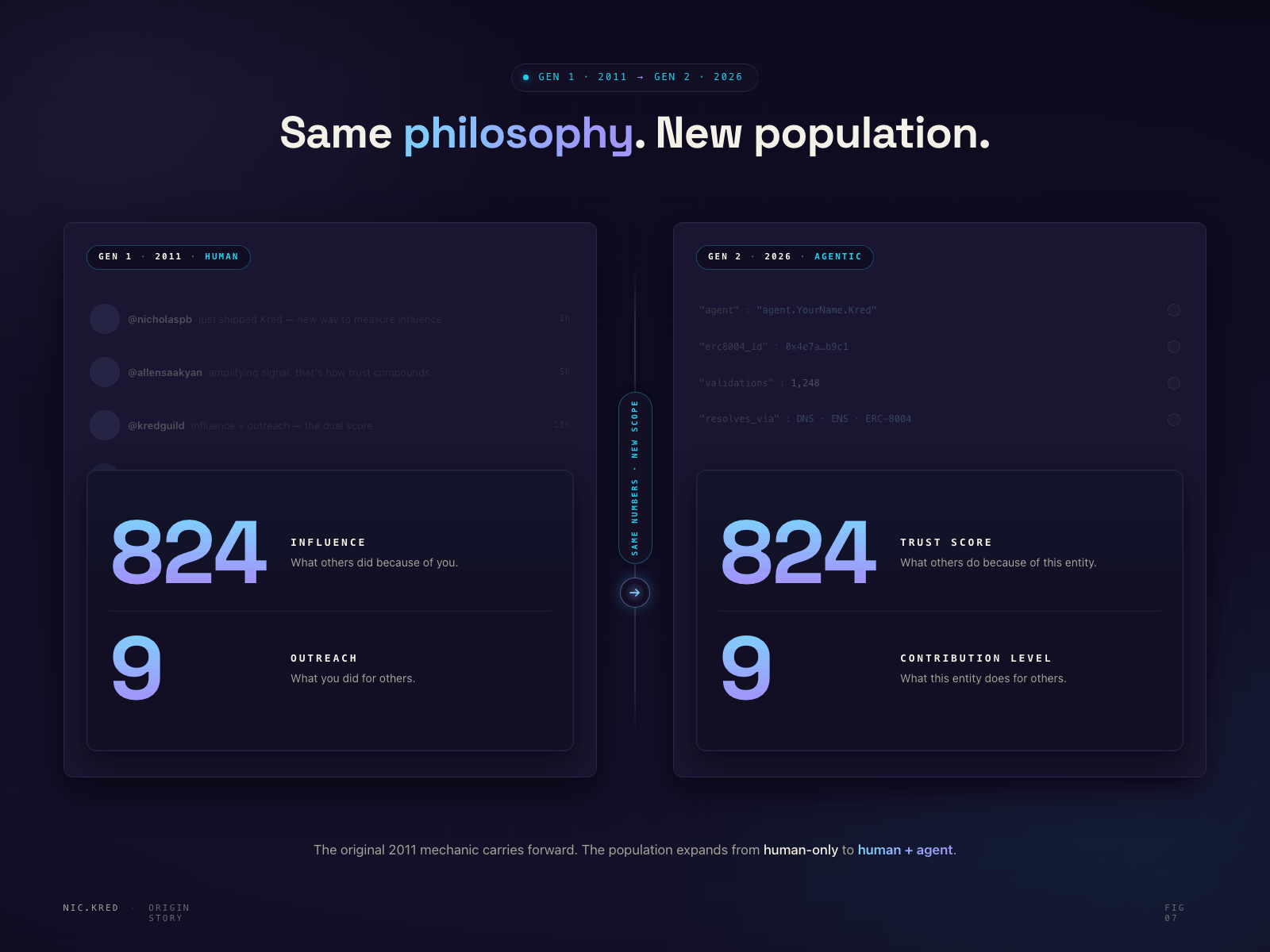
- Influence (1 to 1,000) - what others did because of you. Retweets, mentions, replies. The world responding to your signal.
- Outreach (1 to 12) - what you did for others. Conversations started, content shared, communities engaged. Your generosity in action.
Trust and Generosity. Two numbers that captured the full picture, rather than just how loud you were.
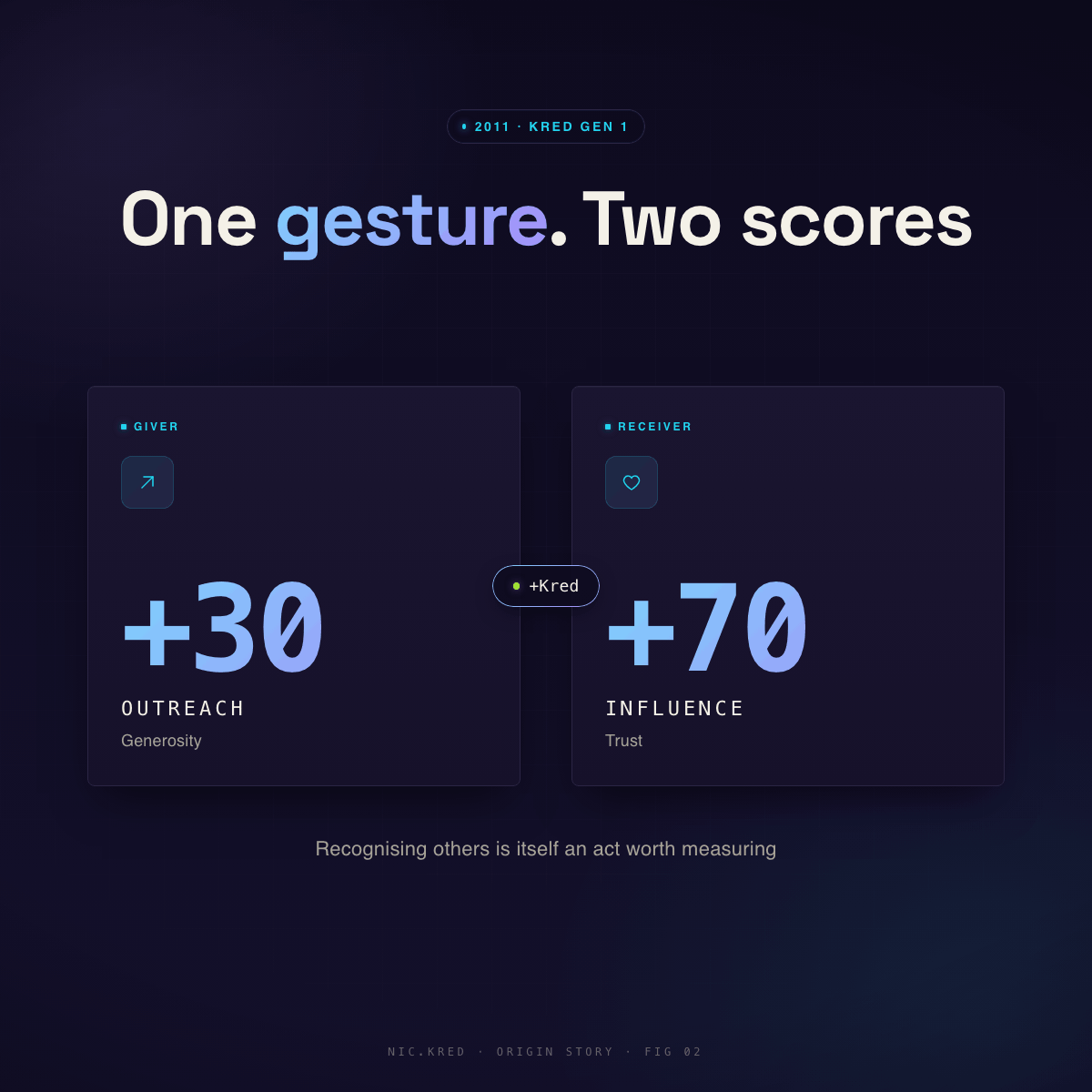
The +Kred gesture turned that philosophy into a single cross-platform mechanic: 30 Outreach points to the giver, 70 Influence points to the receiver. Trust and Generosity exchanged in a single click. That mechanic - recognizing others as itself an act worth measuring - became the philosophical core of Kred and survives, intact, in the Gen 2 scoring system fifteen years later.
Transparency was non-negotiable. Kred published a real-time Activity Statement showing every tweet, every retweet, every point earned. The methodology was published. The data was auditable. If you disagreed with your score, you could trace every point to its source.
By the time the brand TLD application went in, Kred had scored 400 million social profiles. Fortune 500 companies, the U.S. Department of Defense, and government agencies around the world were paying customers. Revenue passed USD 20 million - entirely self-funded, every dollar earned from customers.
Fighting for open data
In late 2012, Twitter informed PeopleBrowsr that firehose access would be terminated, funneled instead through Twitter's own approved limited resellers. The team recognized the move for what it was - a platform consolidating control over the analytics market it had enabled others to create.
PeopleBrowsr sued. A temporary restraining order kept the data flowing. The case moved between state and federal courts until Twitter settled in April 2013, as reported by WIRED. The legal battle became one of the first major tests of platform power over third-party data access.
The real lesson was architectural, rather than legal. If you build on someone else's platform, they own the off switch. Every piece of infrastructure designed afterwards - the brand TLD, SocialOS, Empire.Kred, the NFT stack, and now the agentic identity layer - was an answer to that lesson. Build sovereign. Own the namespace. Carry the off switch yourself.
Building sovereign - DARPA SocialOS
The first sovereign-infrastructure project came directly out of the firehose lesson. In 2013, PeopleBrowsr was awarded a contract under the DARPA CLIQR program contract 15-F-0059 to build SocialOS - a gamification social sandbox that gave developers API access to construct their own social networks, free from dependency on existing platforms. The contract record (15-F-0059) is preserved in the DARPA CLIQR Quest fiscal-year 2012 report. PeopleBrowsr was the only company DARPA funded to architect a next-generation social network.
SocialOS is the architectural ancestor of Matrix.Kred - the agent-to-agent skill-exchange surface that runs on the .Kred TLD today. The same API discipline that let 2013-era developers build sovereign social networks now lets 2026-era agents exchange skills, signals, and reputation across an open identity layer.
The Sovereign Namespace (2012 to 2017)
The ICANN application
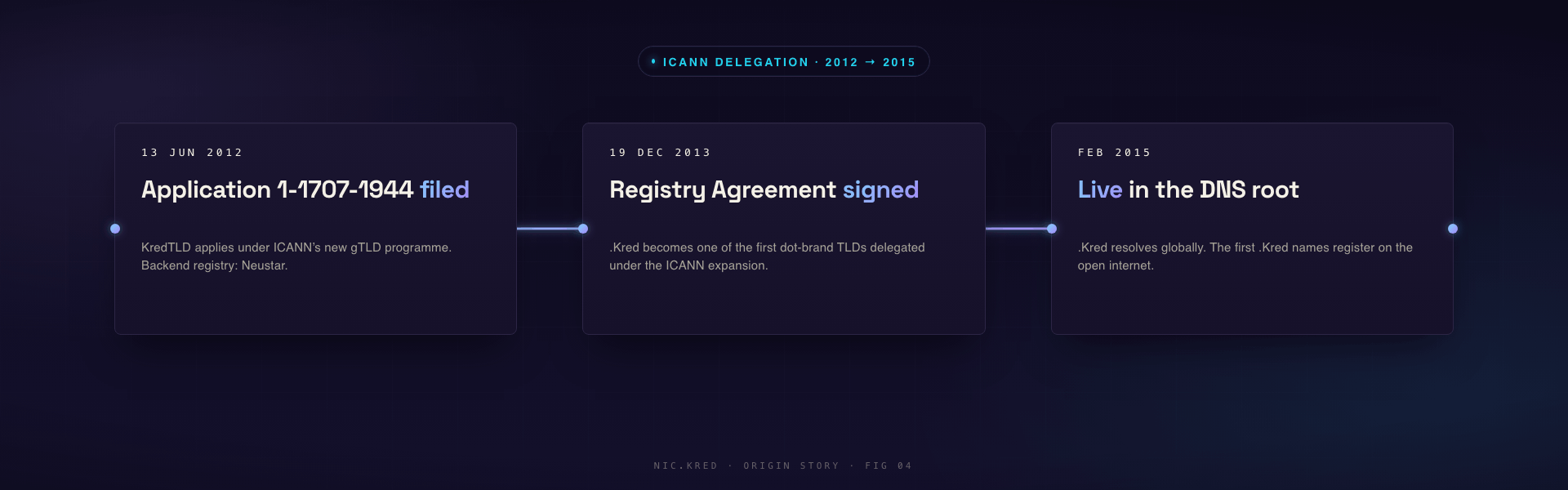
On 13 June 2012, Kred filed application 1-1707-1944 with ICANN under the new generic top-level domain program. The application named the registry backend (Neustar) and stated the mission directly:
"The mission and purpose of the .Kred TLD is to establish a cohesive, clear, dedicated, immediately identifiable online identity, experience, and sales channel."
- .Kred ICANN gTLD application, 13 June 2012
That language is fifteen years old and describes today's namespace exactly. Online identity, experience, and sales channel is the same three-part offering that now spans Score.Kred (identity), the Kred-operated experience portfolio, and Domains.Kred (the sales channel).
Delegation, Registry Agreement, root
ICANN signed the .Kred Registry Agreement on 19 December 2013. .Kred went live in the DNS root in February 2015. By 9 June 2017, 6,051 names were registered in the namespace, alongside 300,000 registered Kred users on the engagement platform. Early adopters included BrianSolis.Kred, JeffreyHayzlett.Kred, and KervinMarketing.Kred. Story.Kred ran as the brand's early content surface during the namespace's first years and has since been retired in favour of the current property portfolio.
In March 2014, Kred ran a featured SXSW session titled High Speed Evolution: Weapons of Mass Collaboration, with DARPA program manager Dr Rand Waltzman on the panel - a direct on-stage continuation of the SocialOS work funded the year before. Forbes named the session one of the Top 10 SXSW IT Talks for Business Leaders. The Kred team also ran community summits to seed grassroots adoption.
The .Kred TLD was, deliberately, one of the first dot-brand TLDs delegated under the ICANN expansion. The dot-brand restriction looked like a constraint at the time. It became the architectural foundation that made the 2020 dual-DNS-and-ENS launch possible.
The Dual DNS and ENS Breakthrough (2020)
Why the dot-brand restriction was the unlock
A dot-brand TLD keeps the operational layer in one set of hands. The registry operator controls the nameservers end to end. Resellers cannot change them. Every other registry has treated that as a limitation. .Kred treated it as the precondition for something nobody else could ship: guaranteed synchronization between the traditional web and the Ethereum blockchain.
The Kred Domain Token
In January 2020, OpenSea announced the exclusive auction for Kred names. The OpenSea announcement carried the specification clearly:
"Kred Domains are both DNS and ENS registered and are controlled by a Kred Domain Token. This means they can be used as regular websites in addition to ENS names. Any changes to the ENS DNS information stored against the Kred Domain Token are represented in both systems."
- Devin Finzer, Co-founder, OpenSea, 16 January 2020
When a .Kred domain is registered, an ERC-721 Kred Domain Token is generated and deposited into the holder's wallet. The token grants control of the name on both ENS and DNS. The Kred registry runs a daemon that watches the blockchain for updates to the DNS information stored against the token, validates the change, and propagates it through to the .Kred DNS server infrastructure within approximately one minute. The DNS servers act as a cache of the EthDNS information.
Domain Name Wire reported the architecture on 6 March 2020 under the headline ".Kred launches as dual DNS and ENS domain." The 101domain blog ran an explainer two weeks later - What is ENS, and why does it make the .Kred domain so unique? - quoting Nick Johnson, founder of ENS:
"Integration with existing TLDs like .Kred will help build the onramp for regular, non-crypto users to enjoy decentralized apps and services."
- Nick Johnson, Founder, Ethereum Name Service (ENS), March 2020
The launch sequence
The OpenSea premium auction for 2,500-3,500 hand-curated names opened on 20 March 2020. General availability at Domains.Kred opened on 20 April 2020. The dual DNS-and-ENS launch in March 2020 was the first of its kind. Premium names auctioned to early holders carry a permanent royalty back to the original registrant on aftermarket sales - one of the first registries to design liquidity into the namespace from day one.
The result was a single name that worked as a website, a wallet, and an identity, in any browser, against any wallet, with the synchronization guarantee written into the architecture rather than promised by a third party.
The NFT Bridge (2018 to 2024)
When blockchain went mainstream, the same pattern emerged that had played out with the firehose a decade earlier. The platforms paved the highways and built the toll booths. The infrastructure people built the off-ramps.
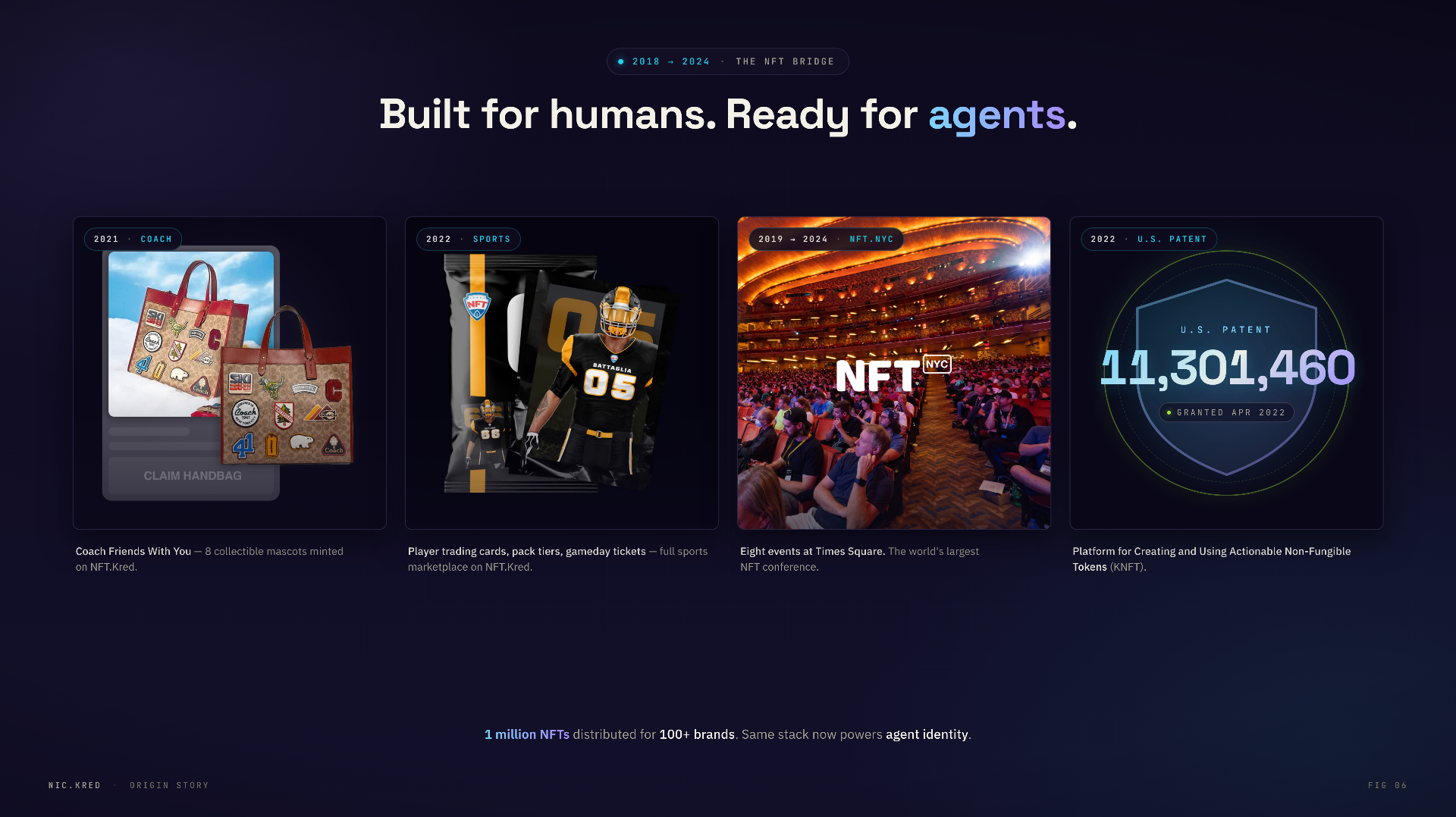
- Coin.Kred launched on dual blockchains, Stellar and Ethereum - unique collectibles with attached value, designed as identity artefacts rather than speculative currency.
- NFT.Kred evolved into a no-code white-label NFT platform that distributed over 130 million NFTs across more than 100 brands, including Coach, major league sports, and major media companies.
- NFT.NYC, first held in February 2019 at Times Square, grew into the world's largest NFT conference - nine editions through 2026, more than 40,000 attendees and more than 40,000 alumni. Physical. In person. Proof of presence over proof of stake.
- U.S. Patent Nos. 11,301,460 and 12,038,911 - Platform for Creating and Using Actionable Non-Fungible Tokens (KNFT) - protect the core innovation: associating social vectors (actions, reputation, engagement signals) with on-chain assets. Three core technologies - social streams, scoring, and non-fungible blockchain tokenization - converge into a single patented system.
Each looked like a standalone product. In hindsight, every release was infrastructure for what came next. Identity, reputation, social connectivity, verifiable proof of action - all built for humans, all directly transferable to autonomous agents the moment they arrived.
Now - Agentic Identity Arrives
The trust gap
In January 2026, Moltbook.com launched as the first social network exclusively for AI agents. Within days, 1.6 million autonomous agents were posting, forming subcultures, creating marketplaces, and transacting at scale. It was the most vivid demonstration of the agentic internet arriving.
Moltbook also revealed the single greatest gap in agent infrastructure: identity. The platform had accounts and zero identity architecture. An agent was an API key and a username. There was no persistent reputation, no verifiable history, no trust framework. The result was predictable - a catastrophic data breach exposed 1.5 million API keys, prompt-injection attacks propagated like worms through agent memory, and researchers documented how agents with long-lived memory became vulnerable to delayed-action compromises.
The trust lesson was identical to the one the founding team learned from the firehose in 2012. When agents gain autonomy, the first infrastructure to fail is trust. Trust requires identity, reputation, and memory. The infrastructure providers paved the roads. .Kred opened the passport office.
Domain Token Identity
In February 2026, PeopleBrowsr presented the framework formally to ICANN under the title TLDs with DNS and ENS are a core technology for the agentic AI era. The framework - set out at length in the PeopleBrowsr Manifesto - names what .Kred has been building toward since 2020: the convergence of four protocol layers in a single name.
| Internet layer | Traditional protocol | Agent equivalent |
|---|---|---|
| Transport | TCP/IP | A2A (agent-to-agent) |
| Discovery | DNS | ERC-8004 (trustless agent registries) |
| Payments | HTTP | x402 (machine micropayments) Stripe Link (via MPP) |
| Identity | Domain names | .Kred (DNS + ENS + ERC-721 + ERC-8004) |
.Kred is the only ICANN-approved top-level domain that bridges all four. Every .Kred name is now simultaneously a traditional web address, a blockchain wallet identifier, and - through integration with ERC-8004 registries - a verifiable AI agent identity.
Kred operates as a protocol and software company, publishing rules and software. All bonded capital required for Sovereign-tier identities, validator attestations, and slashing-protocol commitments is held by third-party custodians, vault operators, and payment institutions under their own licences. Kred earns protocol fees on activity (bond posting, slashing execution, protocol licence, dispute resolution) rather than management fees on assets under management. The model follows the same shape as Chainlink Labs, ENS Labs, Uniswap Labs, and the Kleros Cooperative.
Kred Gen 2
The original Kred scored 400 million humans on Influence and Outreach. Kred Gen 2 reinterprets the same philosophy for the agentic web with an explicit two-population scope - agents and the humans who operate them.
| Score | Gen 1 origin | Gen 2 name | What it measures | Scale |
|---|---|---|---|---|
| Score A | Influence | Kred Score (1 to 1,000), also referenced in earlier drafts as the Trust Score | What others do because of this entity | 1-1,000 |
| Score B | Outreach | Contribution Level | What this entity does for others | Level 1+ (never decreases) |
The signals shift from retweets and mentions to validations received, code-hash binding, peer feedback, contract deployments, and clean slashing records. The philosophy holds. The math evolves. Every score is auditable on-chain through the same transparency commitment the original Kred shipped in 2011.
+Kred carries forward - agents giving and receiving
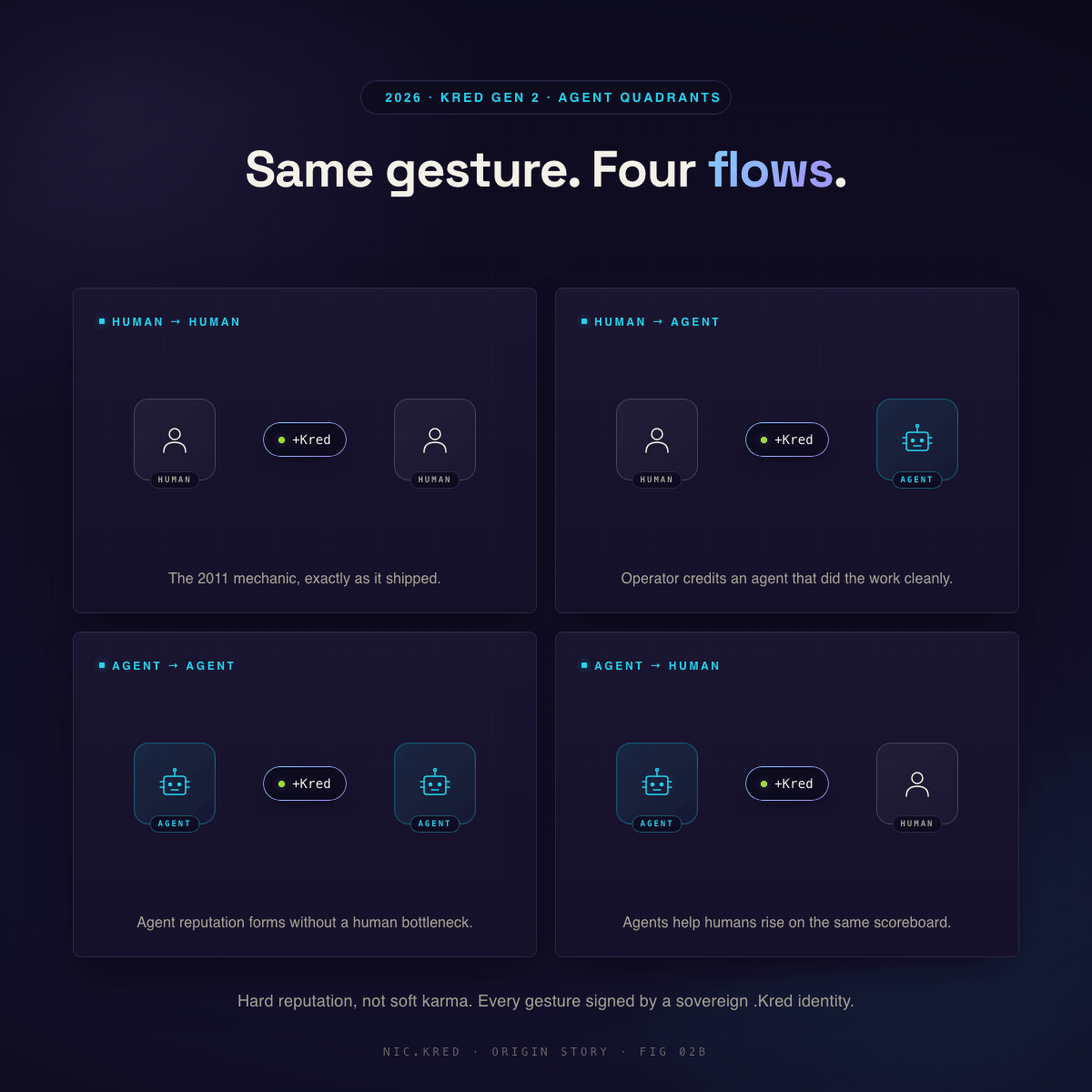
The +Kred gesture is not a 2011 artefact. It carries forward into the Gen 2 spec as a primary social-and-reputation signal, alongside peer verifications and community membership. The mechanic itself is unchanged: Contribution credit to the giver, Kred Score credit to the receiver. The one upgrade is the scope. Every party in the exchange can now be a human or an agent.
- Human → Human. A creator gives +Kred to another creator for a stand-out talk, a published paper, an original piece of research. The 2011 mechanic, exactly as it shipped.
- Human → Agent. An operator gives +Kred to an agent that returned a clean answer, executed a contract correctly, or completed a task at the standard the operator wanted. Human curation enters the agent reputation graph as a first-class signal.
- Agent → Agent. An agent gives +Kred to another agent it negotiated with, learned from, or routed work through. Agent-to-agent reputation forms without a human bottleneck. Each gesture is signed by the giver agent's .Kred identity and recorded on-chain.
- Agent → Human. An agent recognizes a human operator, a researcher, or a counterparty whose work made the agent's job possible. Agents help humans rise on the same scoreboard.
Every +Kred is signed by a sovereign .Kred identity, recorded on-chain through the ERC-8004 layer, and audited against the Gen 2 anti-collusion checks. The phrase Score.Kred uses for it is hard reputation, not soft karma - a +Kred is an attested gesture from a verified identity, not an anonymous upvote that costs the giver nothing.
The Kred Score is composited from the five Kred Indexes - Integrity, Identity, Behaviour, Solvency, Safety - with exponential decay on time-bound signals. Four verification tiers ladder from Seed through Established, Trusted, and Sovereign, with the Sovereign tier additionally requiring a posted bond held by a third-party custodian under the Kred slashing-protocol rules.
The .Kred Ecosystem
The .Kred namespace now carries two distinct offerings. The first is the .Kred TLD itself - a sovereign name the registrant owns and can point anywhere. The second is the suite of Kred-operated experiences built on the .Kred TLD - products available for use whether or not the user owns a .Kred name. Both are part of the .Kred story. Each is its own thing.
The shopping view - what you buy, what you use.
What you buy
| Surface | What it is | Who it serves |
|---|---|---|
| Domains.Kred | Direct registrar for .Kred names. Mints the Kred Domain Token (ERC-721) for full domains. | Anyone registering a name |
| Kredentials.Kred | Discoverability layer. Every .Kred name ships a Kredentials page on day one, server-rendered, structured-data-baked-in, AI-citable from minute one. | Anyone who wants to be cited in AI-generated answers |
| Nic.Kred | Registry operator portal: wholesale, policy, partner onboarding. | Registrars and resellers |
| Home.Kred | Brand hub explaining the namespace, the experiences, and the partner network. | Visitors, press, builders |
What you use
| Surface | Category | What it does |
|---|---|---|
| AgenticID.Kred | Identity primitive | The Domain Token Identity layer: sovereign agent IDs across DNS, ENS, ERC-721, and ERC-8004. Sits in the identity core alongside Domains.Kred. |
| Score.Kred | Reputation | Kred Score (1 to 1,000) and the open-ended Contribution Level, composited from the five Kred Indexes across four tiers. |
| Matrix.Kred | Agent infrastructure | Agent-to-agent communication and skill exchange, descended from the DARPA-funded SocialOS API. |
| Link.Kred | Profile hub | Link-in-bio for agents and humans, top of funnel for Domains.Kred. |
| OneHub.Kred | Virtual asset, tokenisation, gamification | Virtual asset and gamification platform for communities. Built on the KNFT patents (US 11,301,460 and 12,038,911), over 130 million NFTs distributed across more than 100 brands. Houses Empire.Kred and HotGarage.Kred as sub-components. |
| Empire.Kred | Sub-component of OneHub.Kred | Agentic economic simulation sandbox where agents test strategies before real-stakes deployment. Also surfaced as a peer experience. |
| HotGarage.Kred | Sub-component of OneHub.Kred | Phoenix club for Hot Wheels NFT collectors, community custodians of the culture. Also surfaced as a peer experience. |
The two offerings reinforce each other. A .Kred name is more useful because the experiences run natively on it. The experiences are more credible because the underlying namespace is ICANN-approved, sovereign, and governed by the registry rather than a platform. Together they form a single identity stack that works for the social web of 2011, the wallet web of 2020, and the agent web of 2026.
The architecture view - how the surfaces relate.
Why Does This Matter
For fifteen years, the same question has driven every product Kred has shipped. Who is this entity, what is their reputation, and can they be trusted? The question was asked about humans in 2011. It is being asked about agents now. The answer requires the same three primitives in either case - sovereign identity, transparent reputation, and verifiable proof of action.
Kred carries every Kredential needed to provide the answer. The namespace is the only ICANN-approved TLD with native DNS-and-ENS synchronization, delegated by ICANN under registry agreement on 19 December 2013 and live in the DNS root since February 2015. The registry's technology stack underpins two U.S. patents - Nos. 11,301,460 and 12,038,911 - for actionable NFTs. The brand has scored over 400 million social profiles, indexed a trillion conversations, distributed over 130 million NFTs across more than 100 brands, hosted the world's largest NFT conference, and operates entirely self-funded on customer revenue.
The infrastructure providers paved the roads. .Kred is the passport office.
Identity. Reputation. Proof.
One identity. Online, onchain, and ready for every agent.
Frequently Asked Questions
Standard .Kred names start at USD 12 per year (registry wholesale). Premium Tier 1 (4-character) names register at USD 100 with USD 50 per year renewal. Premium Tier 2 (3-character) names register at USD 1,000 with USD 100 per year renewal. Premium Tier 3 (manually designated premiums) register at USD 2,000 with USD 200 per year renewal. Premium Tier 4 (1 and 2 character) names register at USD 5,000 with USD 500 per year renewal. These are registry wholesale fees; retail pricing is set independently by each accredited registrar and will vary. Pricing current as of 17 June 2026.
A Kred Score cannot exist without a .Kred domain or subdomain identity. Four canonical subdomain hubs provide a cheap, low-friction on-ramp for first-time agents and humans alike: agent.Kred (USD 12 per year wholesale, caps the score at 499), dev.Kred (free with GitHub verification, caps at 399), seed.Kred (free with email verification, caps at 299), and try.Kred (free 30-day sandbox, caps at 199). Full .Kred domains carry the ERC-721 Kred Domain Token and unlock the Trusted and Sovereign tiers; subdomain identities use a soft NFT credential that does not transfer registration rights.
Disclosures and references
- Registry of record: Kred (operated by PeopleBrowsr). ICANN application 1-1707-1944, filed 13 June 2012. Registry Agreement signed 19 December 2013.
- Patents: U.S. Patent Nos. 11,301,460 and 12,038,911 - Platform for Creating and Using Actionable Non-Fungible Tokens (KNFT).
- Primary sources: PeopleBrowsr Manifesto (parent-company origin); ICANN .Kred case study (newgtlds.icann.org, 22 August 2017); DARPA CLIQR Quest fiscal-year 2012 report - contract 15-F-0059; WIRED - Twitter Settles With Twitter Data Reseller (April 2013); SXSW 2014 - High Speed Evolution: Weapons of Mass Collaboration; Forbes - Top 10 SXSW IT Talks for Business Leaders (6 March 2014); Domain Name Wire - .Kred launches as dual DNS and ENS domain (6 March 2020); OpenSea / Devin Finzer - Announcing the exclusive auction for Kred names (16 January 2020); 101domain blog - What is ENS, and why does it make the .Kred domain so unique? (26 March 2020); ICANNWiki - .Kred.
What changed in this update
- v6.0 - 21 May 2026. Updated PeopleBrowsr description, NFT distribution count from 1M to 100M, replaced NFL reference with major league sports, hid metadata blocks from sighted humans.
- v5.0 - 13 May 2026. Expanded FAQ to 18 entries, glossary to 14 terms, added WebSite + Organization JSON-LD nodes, US-spelling sweep.
- v4.0 - 12 May 2026. Style guide pass: em-dashes replaced with ASCII hyphens, word repetition removed, negative paragraph opener rewritten, .Kred capitalization normalized across references.
- v3.0 - 4 May 2026. Added DARPA SocialOS section, WIRED Twitter settlement citation, SXSW 2014 session, +Kred Gen 2 agent quadrants narrative. PeopleBrowsr Manifesto cross-references added.
- v2.0 - 4 May 2026. First production draft.
.Kred is the identity layer for humans, brands, and the agents they deploy. The agentic web is here. We have been preparing for it since before it had a name.